Understanding ADHD Symptoms: Beyond the Checklist
A clear breakdown of ADHD symptoms, inattentive and hyperactive, and why a checklist alone never fully explains what's going on.

.svg)

Ask most people to describe ADHD symptoms and you'll get a version of the same image: a kid who can't sit still, blurts out answers, and can't seem to focus on anything. That picture is accurate for some people and badly incomplete for a lot of others. Understanding ADHD symptoms well means understanding both what the criteria actually say and what they routinely miss.
Clinicians use the DSM-5 to diagnose ADHD, and it organizes symptoms into two domains: inattention and hyperactivity-impulsivity. For a diagnosis, children up to age sixteen need six or more symptoms from one or both domains; adolescents seventeen and older, and adults, need five or more (CDC, 2024). Symptoms have to be present for at least six months, show up in more than one setting, like home and school or home and work, and be inconsistent with a person's developmental level, not just personality quirks or a bad week.
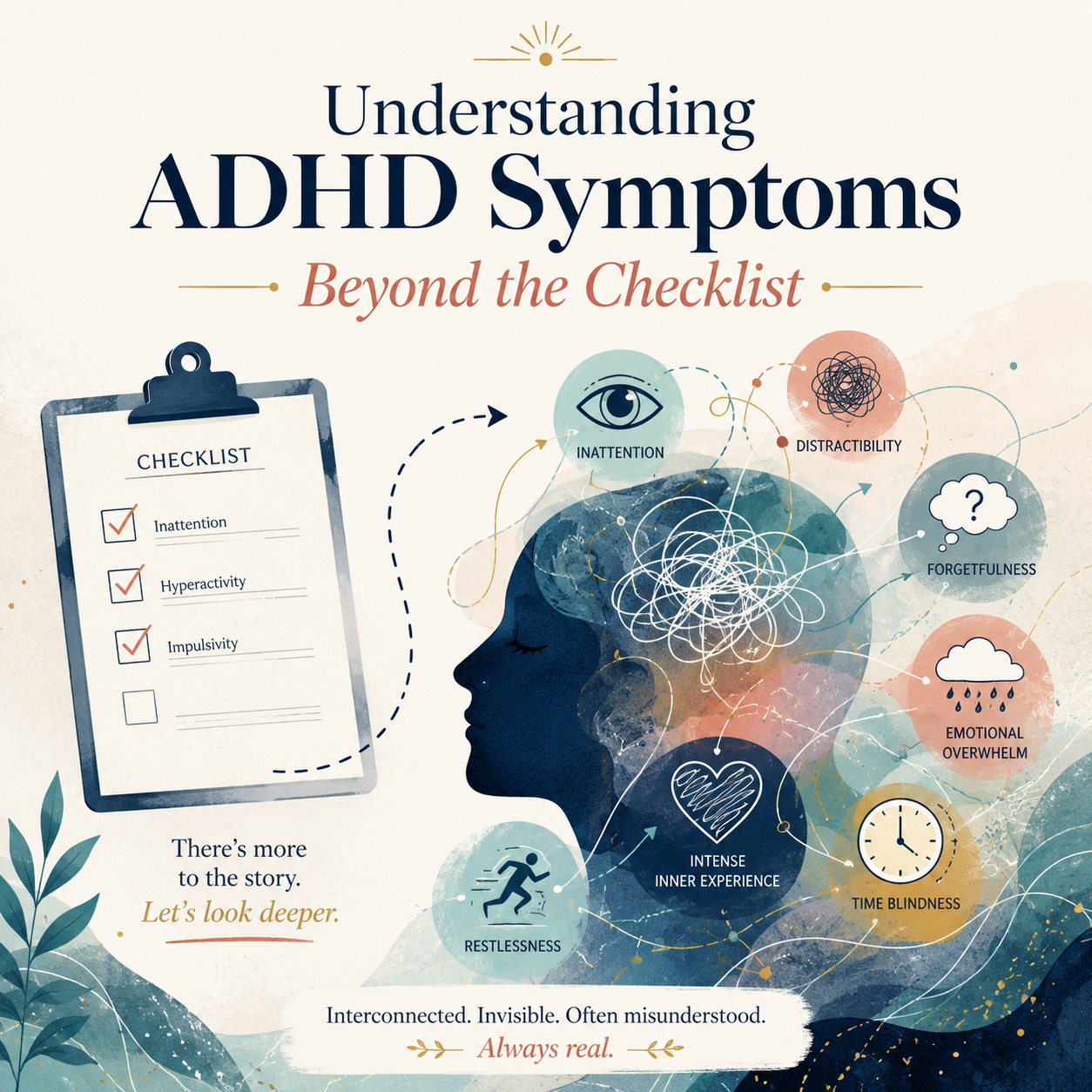
Inattentive symptoms include things like difficulty sustaining attention, not seeming to listen when spoken to directly, trouble following through on instructions, losing things needed for tasks, and being easily distracted. Hyperactive-impulsive symptoms include fidgeting, difficulty staying seated, excessive talking, blurting out answers, and trouble waiting your turn. Depending on which domain dominates, a person is classified as predominantly inattentive, predominantly hyperactive-impulsive, or combined presentation.
That's the clinical skeleton. It's useful, and it's also easy to misread if you stop there.
Two things get lost when people only look at the symptom list.
First, hyperactivity doesn't always look like bouncing off the walls. It can be internal: constant mental restlessness, racing thoughts, a sense of being wound up even while sitting still. This presentation is more common than the classic picture suggests and is frequently missed, especially in adults and in women, because it doesn't disrupt a classroom the way visible hyperactivity does.
Second, and more fundamentally, the DSM-5 describes behavior. It doesn't explain why the behavior happens, and that's where a lot of people, including well-meaning friends and family, draw the wrong conclusion. Dr. William Dodson, a psychiatrist who has worked with adult ADHD for decades, describes the ADHD brain as running on what he calls an interest-based nervous system, engaged by interest, novelty, and urgency rather than by importance alone. That reframes symptoms that look like carelessness or defiance from the outside. A person isn't failing to start the tax paperwork because they don't care. Their brain's engagement system genuinely isn't switching on for a task that offers no interest, novelty, or immediate urgency, no matter how important they know it is.
That distinction matters practically and personally. "Why can't you just focus" assumes a choice that isn't actually available in the moment the same way it is for someone without ADHD. Understanding the mechanism changes how you respond, whether you're the one with the diagnosis or the one living alongside someone who has it.
Here's where I want to add something the DSM-5 was never designed to address.
A list of symptoms is a tool for diagnosis, not a description of someone's worth or a complete account of who they are. I've watched people, especially after a fresh diagnosis, start reading every part of their personality through the lens of the criteria, until "I forgot" becomes "that's my ADHD" and "I got distracted" becomes evidence of a deficit rather than just something that happened. The symptoms are real and worth naming accurately. They are not the whole of a person.
Scripture pictures the body, and by extension the person, as something deliberately varied by design, not accidentally assembled. Paul writes, "God arranged the members in the body, each one of them, as he chose" (1 Corinthians 12:18, ESV). That verse is about spiritual gifts and the church, but the underlying claim, that variation in how people are built is intentional rather than a manufacturing defect, applies just as well to a brain that processes attention differently. A nervous system that runs on interest and urgency instead of importance is not a lesser version of a "correct" brain. It's a different arrangement, still within the range of how people are actually built, still worth understanding on its own terms rather than measured entirely against a different design.
That doesn't mean the symptoms don't cost something. They do. Missed deadlines have real consequences. Relationships strain under forgotten commitments. None of that gets minimized by pointing to a good theology of design. But the difficulty is not evidence that something has gone wrong with a person's fundamental worth. It's evidence that a particular kind of mind is operating in systems, schools, workplaces, and marriages, that were mostly built around a different kind of mind.
If you're trying to understand your own symptoms or someone else's, a few things help:
Separate the behavior from the character judgment. "I lost the paperwork again" is a fact. "I'm irresponsible" is an interpretation, and usually the wrong one.
Notice whether hyperactivity is internal. Racing thoughts and internal restlessness count, even when nothing external looks unusual.
Ask what's driving engagement, not just willpower. If a task keeps getting avoided despite good intentions, the honest question isn't "why don't I care," it's "what would make this interesting, novel, or urgent enough to actually start."
Hold the diagnosis and the person as two different things. The symptoms explain patterns. They don't summarize a life.
Understanding ADHD symptoms starts with the DSM-5 criteria, but it doesn't end there. The real picture includes hyperactivity that hides inside a still body, an engagement system that runs on different fuel than most people's, and a person underneath all of it who was arranged deliberately, not defectively. Learn the symptoms. Just don't let them become the whole definition of anyone who has them.


.svg)
.svg)