Do I Have ADHD? How to Actually Find Out
ondering if you have ADHD? Here's why a TikTok checklist can't answer that, and what an actual evaluation involves.
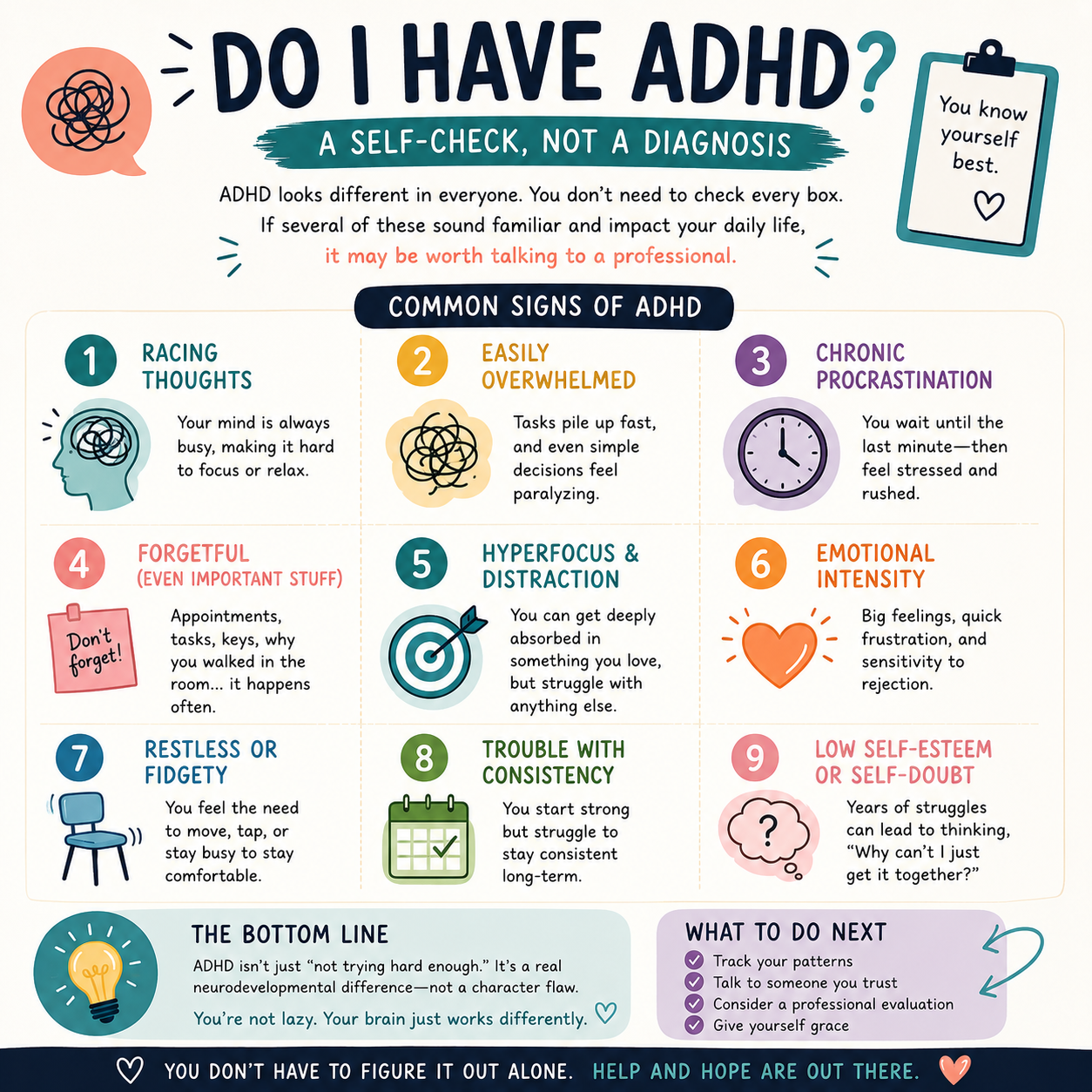

.svg)

You've probably landed here because a video, a friend, or your own frustrating week made you wonder. That's a common enough experience that there's data on it: a recent survey found roughly one in four adults suspect they have undiagnosed ADHD, while the actual estimated prevalence in adults is closer to 6 percent. That gap is worth sitting with before you answer the question for yourself.
Here's what actually separates "I relate to some of these traits" from "I have ADHD," and why the difference matters more than it might seem.
Since around 2020, ADHD content has exploded across TikTok, Instagram, and YouTube. A lot of it is genuinely helpful for people who already have a diagnosis. A lot of it is also not accurate. Research analyzing the most popular ADHD content on these platforms has repeatedly found that a large share, in some studies more than half, is misleading by clinical standards, often describing traits that aren't part of the actual diagnostic criteria at all, or presenting completely ordinary human experiences (losing your keys, procrastinating on a boring task, zoning out in a long meeting) as if they're symptoms on their own.
That matters because almost everyone will recognize themselves in some of those videos. Forgetting things, getting distracted, feeling restless: these are common human experiences, not automatically evidence of a disorder. What separates a trait from a diagnosis is persistence, pervasiveness, and impairment: symptoms present since childhood, showing up across more than one setting, and causing real, ongoing difficulty, not just an occasional bad week or a personality you don't love.
A real ADHD evaluation is not a five-minute quiz. Clinicians typically conduct a structured assessment lasting one to two hours, sometimes across multiple sessions, gathering history from childhood onward, ruling out other conditions that commonly mimic ADHD, like anxiety, depression, sleep disorders, or trauma, and often collecting input from people who've known you a long time, like parents or a spouse, since self-report alone can miss patterns that were more visible to others.
That thoroughness exists for a good reason. Anxiety and ADHD both cause difficulty concentrating. Depression and ADHD both cause low motivation and forgetfulness. A traumatic history can produce hypervigilance that looks a lot like inattention from the outside. Diagnosing based on a symptom checklist alone risks missing the actual, underlying issue, and treating the wrong thing rarely helps and sometimes makes things worse.
Here's the tension worth naming honestly: both underdiagnosis and overdiagnosis are real problems, at the same time. For decades, ADHD, especially in adults and especially in women, was genuinely missed. That history is real, and it's part of why so many people are actively looking for answers now. But the corrective for decades of underdiagnosis isn't jumping straight to self-diagnosis based on a hashtag. It's pursuing an actual evaluation, so the answer you land on is the right one, whichever direction it goes.
Proverbs puts this more plainly than any research summary: "The one who states his case first seems right, until the other comes and examines him" (Proverbs 18:17, ESV). Your own read on yourself, however sincere, is one account, not a verdict. That's not a knock on your self-awareness. It's just an honest acknowledgment that a single perspective, even your own, benefits from real examination before it becomes the final word.
If you've been wondering whether you have ADHD, here's a more useful path than another online quiz:
Track the pattern honestly. Has this been a lifelong struggle, visible since childhood, or is it a more recent development tied to a specific season of stress, sleep loss, or life change? Both are worth addressing, but they point toward different explanations.
Get evaluated by someone qualified. A primary care physician, psychiatrist, or psychologist experienced with adult ADHD can walk you through a proper assessment. This isn't about proving or disproving a hunch quickly. It's about actually finding out.
Hold the uncertainty without rushing to close it. You don't need to resolve the question this week by matching yourself to a symptom list. An honest "I don't know yet, and I'm getting a real answer" is a more solid place to stand than a confident self-diagnosis built on a two-minute video.
Let the answer, whatever it is, be useful. If it's ADHD, you'll have access to real treatment and an explanation that actually fits. If it's something else, anxiety, sleep deprivation, a season of burnout, you'll be treating the actual problem instead of the one that happened to trend online this month.
Wondering if you have ADHD is a reasonable question, and the fact that you're asking it seriously, rather than settling for a TikTok checklist, is a good sign, not a bad one. The honest answer takes more than a quiz and more than a gut feeling. It takes an actual evaluation, from someone qualified to give one, and enough patience to let the examination, not just your own first impression, tell you what's really going on.


.svg)
.svg)