ADHD Without Medication: What Actually Works
Meta Description: What the evidence says about managing ADHD without medication, what genuinely helps, and where non-medication approaches fall short.

.svg)

People choose to manage ADHD without medication for real reasons: side effects, personal conviction, pregnancy, a history of substance use that makes stimulants a genuine risk to weigh carefully, or simply wanting to try other approaches first. That's a legitimate starting point. Here's what the evidence actually supports, and where it falls short.
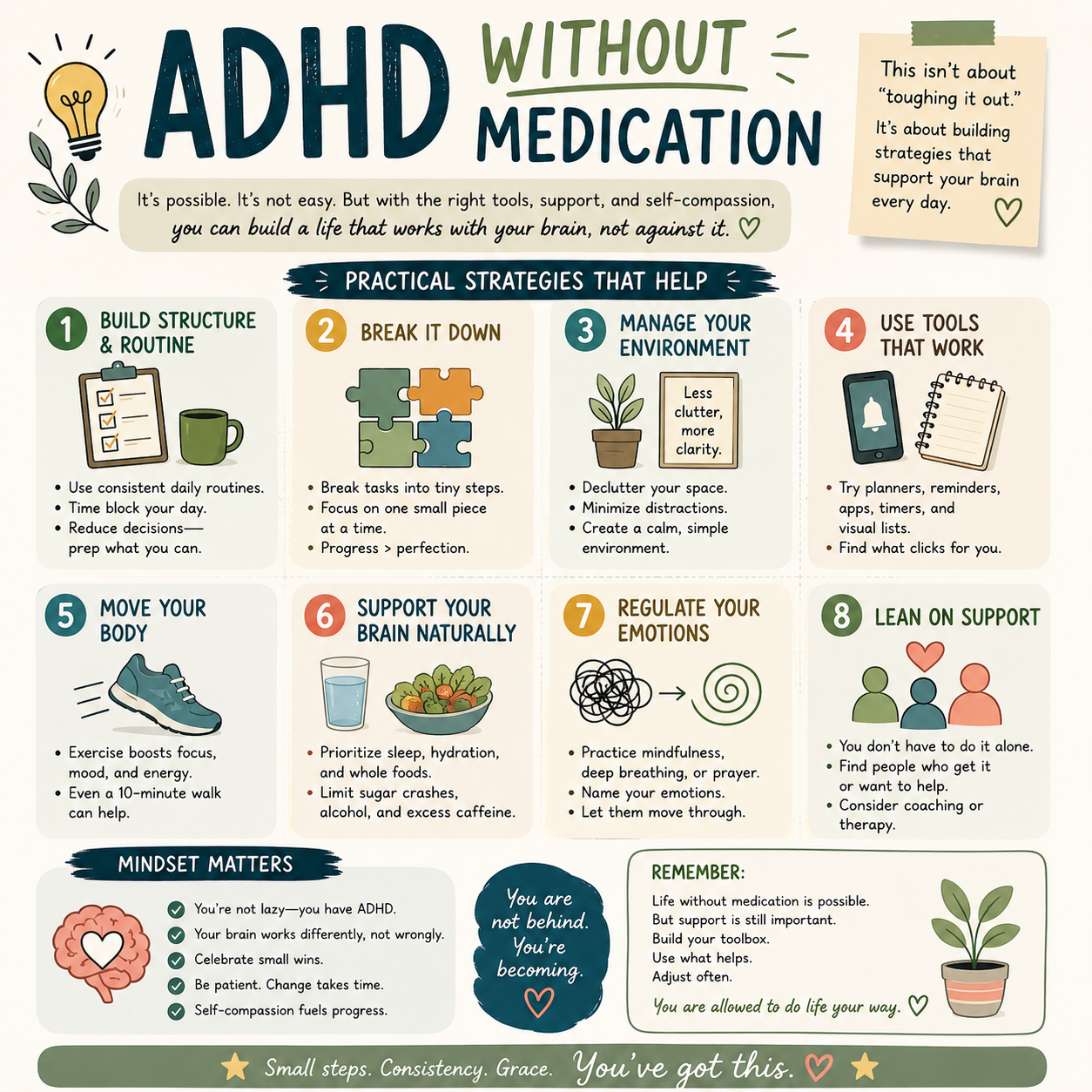
Behavior therapy, especially for children. Current guidelines recommend behavioral training as the first-line treatment for young children, before medication, and research backs that sequencing. One study found that starting treatment with behavioral intervention led to better outcomes than starting with medication and adding behavior therapy later; children who began with medication showed more difficulty once it was withdrawn, likely because they'd had fewer chances to build their own self-regulation skills.
Cognitive behavioral therapy, for adults. A 2025 systematic review and meta-analysis found CBT significantly more effective than control conditions for core ADHD symptoms in adults, with meaningful effects holding up in both the short and long term. This is one of the better-supported non-medication options available for adults specifically.
Physical exercise. Regular exercise has a real, measurable effect on inhibitory control and executive function in children and adolescents with ADHD, and it's consistently one of the stronger non-pharmacological interventions studied. The effect can weaken after the exercise stops, which is less an argument against it and more a case for making it a routine rather than a one-time fix.
Structured coaching and external systems. Parent training in behavior management has strong evidence behind it for improving child behavior, and structured coaching for adults, externalizing tasks, building routines, reducing environmental friction, consistently helps day-to-day functioning even where it doesn't directly reduce the underlying neurological symptoms.
Not everything marketed as a natural ADHD fix holds up. Reviews of non-pharmacological interventions have found that standalone approaches like mindfulness, neurofeedback, and neurocognitive training on their own can't currently be recommended for controlling core ADHD symptoms due to limited evidence, even though they may help with related outcomes like social skills or academic performance. Meditation, EMG feedback, and general brain-training games specifically failed to show meaningful improvement in some direct comparisons. If a program promises to resolve ADHD symptoms without medication or without addressing the underlying attention and regulation mechanisms directly, that claim deserves real skepticism.
Here's the part that doesn't fit neatly into a "natural vs. medicated" framing: for moderate to severe ADHD, medication remains the most effective single intervention for core symptoms, and behavioral approaches tend to work best in combination with it, not as a full substitute, particularly for more significant impairment. That doesn't mean non-medication approaches don't work. It means they work differently, often more slowly, and with better results for day-to-day functioning than for the core neurological symptoms themselves.
This is a genuine decision with real trade-offs, not a test of willpower or conviction. Someone choosing behavior therapy, exercise, and structured coaching over medication isn't taking an easier path or a harder one. They're choosing a different one, with different strengths, and it deserves to be made with a clinician who can help track whether it's actually working, not assumed to work simply because it avoids medication.
Scripture is direct about the value of counsel over going it alone: "Without counsel plans fail, but with many advisers they succeed" (Proverbs 15:22, ESV). That applies here plainly. Deciding to manage ADHD without medication isn't a decision to make in isolation, based on a preference or a fear of side effects alone. It's worth making alongside a physician or clinician who can help you honestly track whether the approach you've chosen is actually reducing impairment, or whether it's simply the option that felt more comfortable to start with.
Managing ADHD without medication is a legitimate choice with real evidence behind several specific approaches: behavior therapy for children, CBT for adults, consistent exercise, and structured external systems. It's not a legitimate choice if it means avoiding evaluation altogether, or trusting an unproven method because it promises a fix medication supposedly can't offer. Whatever path you choose, choose it with real information and real support, not just a strong preference for one label over another.


.svg)
.svg)