ADHD in Women: Why It's Missed and What to Do
Why ADHD in women is so often missed or misdiagnosed, how it presents differently, and a whole-person approach to getting real help.
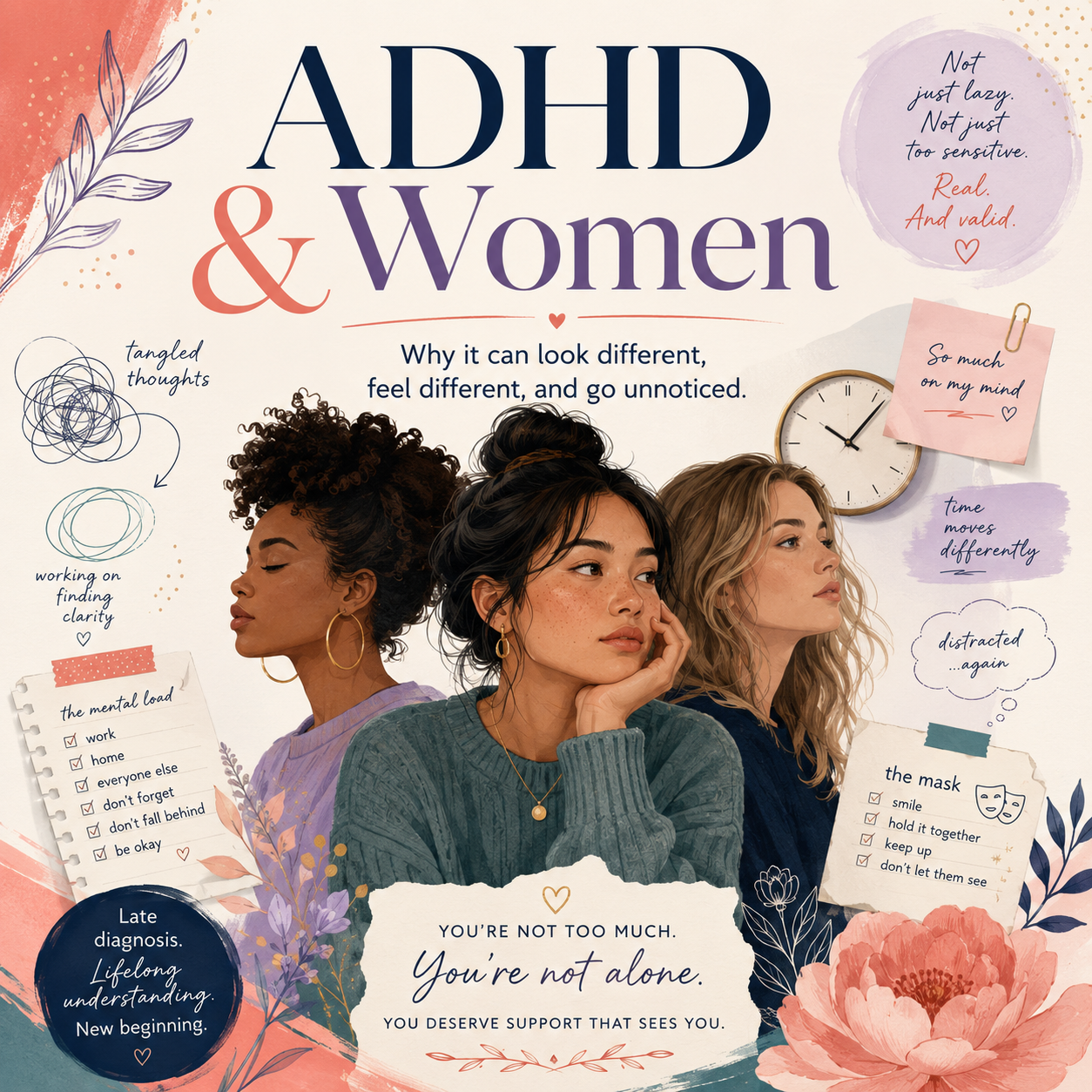

.svg)

A woman sits across from me in my office, usually somewhere between her thirties and fifties, and says some version of the same sentence: "I don't know why I'm only figuring this out now." She has spent decades being called scattered, too sensitive, disorganized, a daydreamer. She has built an entire adult life managing symptoms she didn't have a name for. And she is angry, relieved, and grieving all at once, often in the same session.
That story is common enough that it has a name in the research literature: the lost girls. If you're a woman wondering whether ADHD explains a lifetime of feeling like you were working twice as hard to keep up, here's what the evidence says, and why understanding this well takes more than a diagnostic checklist.
For decades, ADHD research was built almost entirely on studies of boys. The diagnostic criteria, the classic picture of a hyperactive child bouncing off the walls, and the tools clinicians used to screen for it were all calibrated to a male presentation. Girls with ADHD were, and often still are, evaluated against a standard that was never built with them in mind.
That mismatch shows up in the numbers. Childhood ADHD is currently diagnosed in boys at roughly twice the rate of girls, a gap researchers increasingly attribute to underdiagnosis in girls rather than a genuine difference in who develops the condition. Recent research presented at the European College of Neuropsychopharmacology found that women are diagnosed with ADHD an average of five years later than men, despite symptoms typically emerging at the same age (ECNP, 2025). Five years is not a rounding error. It's five more years of unexplained struggle, five more years of a young woman concluding that the problem is her character rather than her neurology.
Part of the reason is presentation. Women with ADHD are more likely to show the inattentive type: disorganization, forgetfulness, difficulty sustaining focus, and internal restlessness, rather than the overt hyperactivity and impulsivity that tends to get a child referred for evaluation. Dr. Judith Joseph, a psychiatrist who studies this gap, points out that girls are often acculturated to be ladylike and to sit still, which pushes many of them to mask their symptoms well enough to avoid ever being flagged for evaluation. Masking is exhausting. It's also invisible by design, which is exactly why it works so well at delaying a diagnosis, and exactly why it costs so much.
Here's something that rarely makes it into general ADHD content: symptoms in women are not static across the lifespan. A 2026 study out of Monash University's HER Centre Australia found that a large majority of women with ADHD reported their symptoms changed with hormonal shifts: worsening after childbirth, fluctuating across the menstrual cycle, and intensifying significantly during the menopause transition. This isn't a side note. It means a woman's ADHD experience at twenty may look meaningfully different from her experience at forty-five, and a treatment plan built once and never revisited will eventually stop fitting.
It also means some women are misdiagnosed with anxiety or depression during perimenopause when what's actually happening is a long-standing, previously compensated-for ADHD becoming harder to mask as hormonal shifts erode the coping strategies that used to work. Untangling that requires a clinician who's actually looking for it.
Here's where I want to slow down, because a diagnosis, however overdue and validating, is not the same thing as an identity.
I've sat with women who received an adult ADHD diagnosis and felt, for the first time, like their whole life finally made sense. That relief is real and I don't want to minimize it. But relief can curdle into something else if the diagnosis becomes the entire lens through which a woman understands herself: not just "I have ADHD" but "ADHD is who I am, and it explains and excuses everything." That's not freedom. That's just trading one flattened story for another.
Scripture offers a sturdier starting point. Psalm 139 says, "For you formed my inward parts; you knitted me together in my mother's womb... I praise you, for I am fearfully and wonderfully made" (Psalm 139:13-14, ESV). Notice what that psalm does not do. It doesn't wait for a clean bill of health before declaring the person wonderfully made. The psalmist is fearfully and wonderfully made in a body that will still get sick, still age, still struggle. The wonder isn't contingent on the absence of difficulty. It's true underneath it.
That matters for how a woman holds a late ADHD diagnosis. You are not a lifetime of missed accommodations plus a brain chemistry problem. You are a person, made deliberately and known intimately, who also happens to have a brain that processes attention and regulation differently than the model clinicians were originally trained to look for. Both things are true. Neither one cancels the other.
This is also where I push back on any framing, secular or Christian, that treats the body as incidental. Some Christian spaces have historically treated the mind and spirit as the "real" self and the body, including a body with ADHD, as something to simply discipline into submission through more willpower or more prayer. That's not a biblical anthropology. It's a functional Gnosticism, and it leaves women who've already spent decades being told to just try harder with one more voice telling them the same thing. The brain that struggles with executive function is not a spiritual failure to overcome. It's part of an embodied person, currently marked like every other body by the ordinary effects of living in a fallen world, worth treating with real clinical tools rather than shame.
A few things matter more than most general ADHD content acknowledges:
Get evaluated by someone who knows the female presentation. Not every clinician is trained to recognize inattentive-type ADHD or to separate it from anxiety and depression, which frequently co-occur and can mask or mimic it. If you've been treated for anxiety for years and it never quite resolves, ADHD is worth ruling in or out.
Expect your plan to need revisiting. Because symptoms shift with hormonal changes, a medication dose or coping strategy that worked at thirty may need adjustment at forty-five. That's not a failure of the original plan. It's an expected part of managing a condition across a woman's whole lifespan.
Grieve the years you didn't have a name for it, without staying there. Many women describe real grief when they're finally diagnosed, mourning the version of themselves that could have had support decades earlier. That grief is legitimate. It's also not the final word.
Let the diagnosis explain, not excuse or define. ADHD explains real patterns. It doesn't excuse every choice, and it isn't the whole of who you are.
ADHD in women has been missed for decades, not because it's rare, but because the field was built to notice a different presentation. If that story sounds like yours, a proper evaluation is worth pursuing, and it may explain more than you expect. But whatever the diagnosis clarifies, it was never going to be the foundation of your worth. That foundation was already there, fearfully and wonderfully laid, long before anyone had a clinical word for what you were carrying.


.svg)
.svg)