ADHD in Women: 6 Things You Should Know
The key facts about ADHD in women, why it's missed for years, and what makes it look different than the male-centered stereotype.
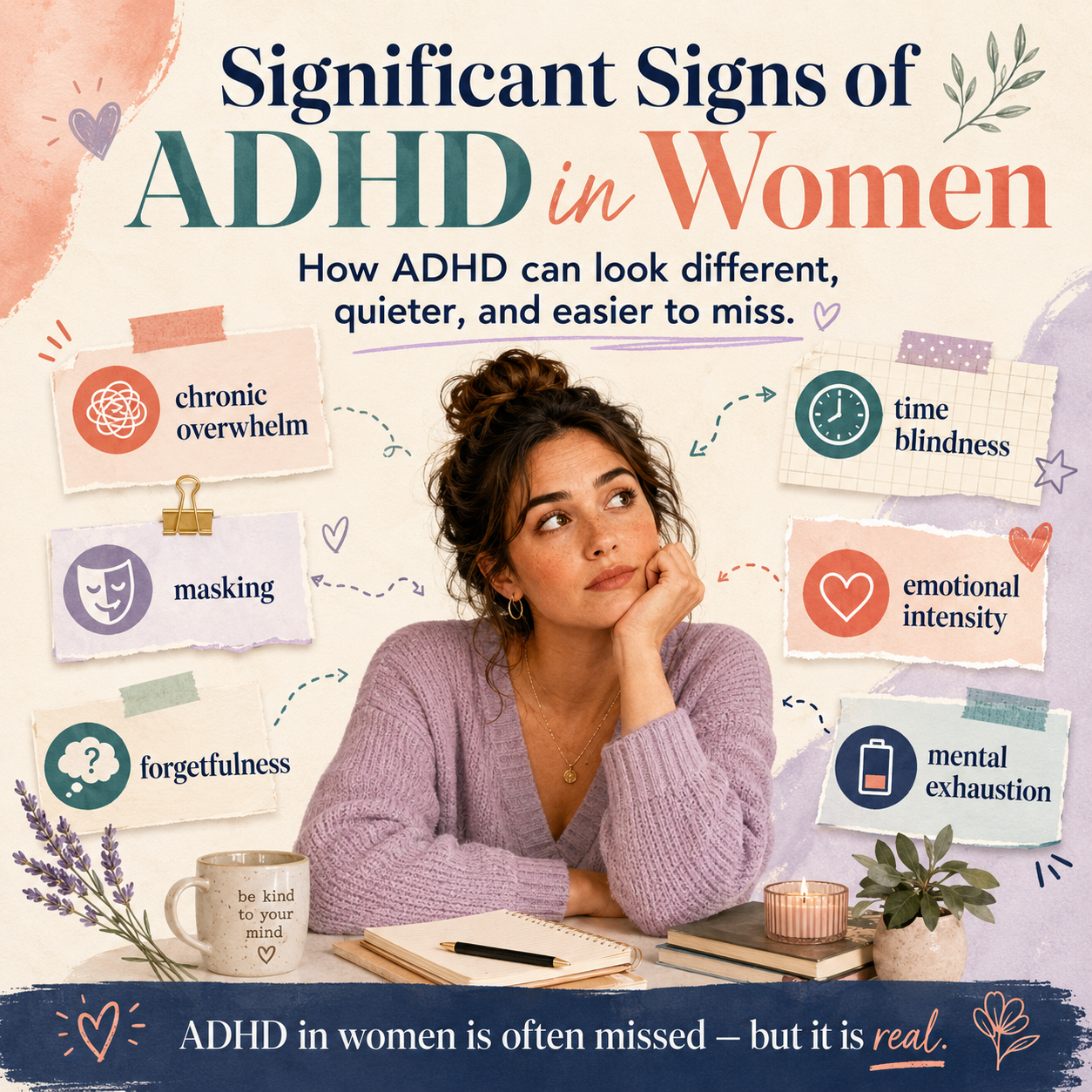

.svg)

ADHD research was built almost entirely on studies of boys for decades. That history still shapes who gets diagnosed today, and who doesn't. Here are the major points worth knowing.
1. Women are diagnosed roughly five years later than men. Recent research presented at the European College of Neuropsychopharmacology found this gap despite symptoms typically emerging at the same age (ECNP, 2025). Five years is five more years of unexplained struggle before anyone has a name for it.
2. Girls are diagnosed at about half the rate of boys, and it's likely not because they have ADHD less often.Researchers increasingly attribute this gap to underdiagnosis rather than a genuine difference in who develops the condition. The diagnostic criteria and screening tools were largely built and standardized on male samples.
3. Women more often present as inattentive rather than hyperactive. Disorganization, forgetfulness, and internal restlessness are harder to spot than the visible hyperactivity that tends to get a child referred for evaluation. A girl who's quietly daydreaming rarely gets flagged the way a boy bouncing off the walls does.
4. Masking is common, and it's exhausting. Girls are often acculturated to be ladylike and to sit still, which pushes many toward masking symptoms well enough to avoid detection. Masking isn't a sign things are fine. It's a sign a lot of effort is going into looking fine, and that effort eventually runs out.
5. Symptoms shift across a woman's hormonal life stages. A 2026 study from Monash University's HER Centre Australia found that a large majority of women with ADHD reported symptoms worsening after childbirth, fluctuating with the menstrual cycle, and intensifying significantly during the menopause transition. A treatment plan built once at twenty-five may need real adjustment by forty-five.
6. Comorbidities are common and can obscure the diagnosis. Anxiety, depression, and premenstrual dysphoric disorder frequently co-occur with ADHD in women, and a woman treated for anxiety for years without real improvement is a common story worth re-examining rather than assuming the treatment just isn't working.
None of this is trivia. It's the reason so many women reach their thirties, forties, or later before getting an answer that actually fits, after years of being told they were scattered, too sensitive, or just needed to try harder. If several of these points sound familiar, particularly the later-life symptom shifts or a stalled anxiety diagnosis, it's worth raising ADHD specifically with a clinician who understands how it presents outside the male-centered stereotype.
A diagnosis, however overdue, was never going to be the whole story of who you are. But it can be the thing that finally explains a pattern you've been managing alone for a long time, and that's worth pursuing honestly rather than guessing at indefinitely.


.svg)
.svg)