ADHD and Productivity: Why Standard Advice Fails
Why typical productivity systems don't work for ADHD brains, what actually helps, and why your worth was never tied to your output.

.svg)

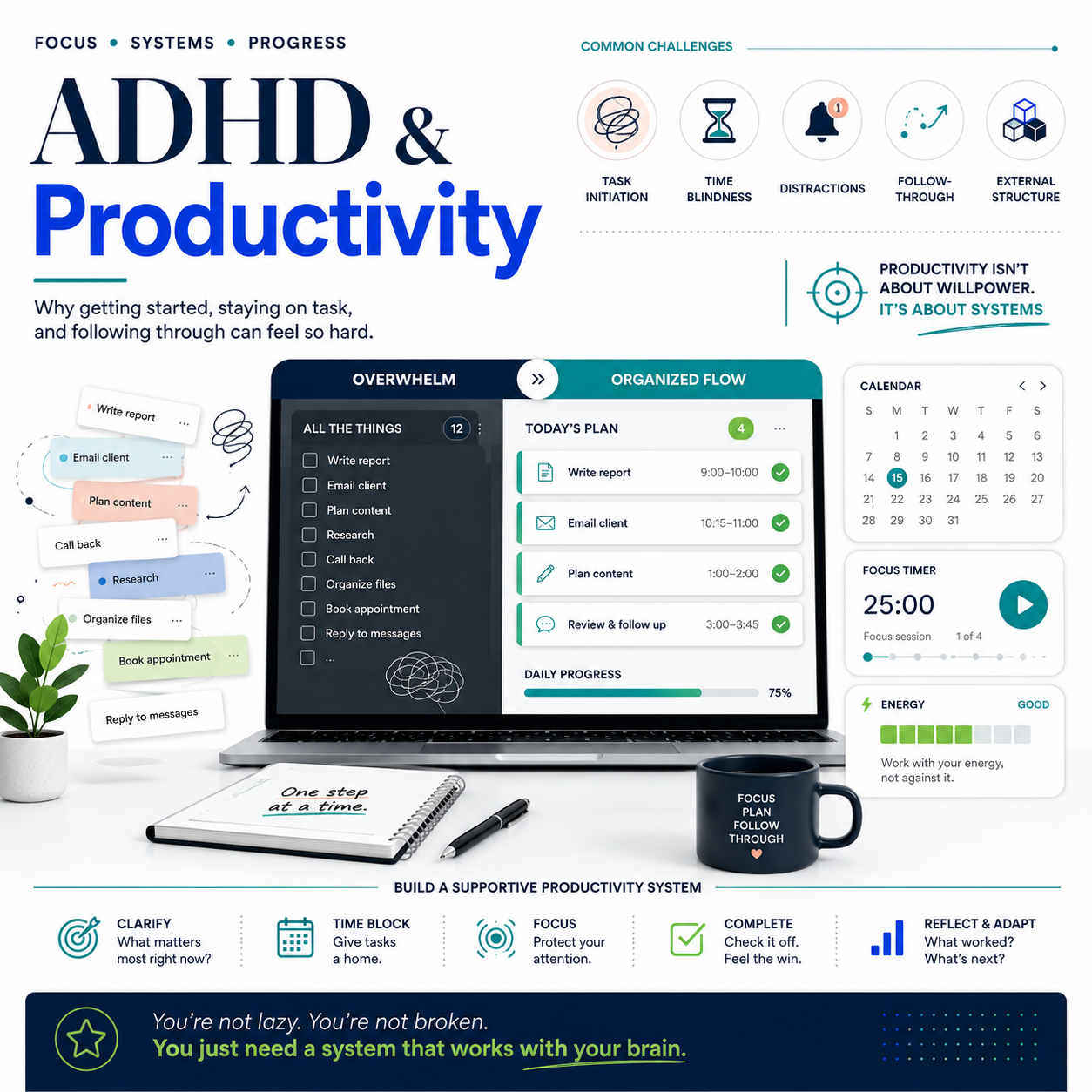
Most productivity advice assumes a brain that doesn't exist if you have ADHD. It assumes stable attention, reliable time perception, and motivation that shows up simply because a task is important. Getting Things Done, the Pomodoro Technique, a color-coded planner, all of it presupposes executive functions that ADHD, by definition, affects.
That's not a character problem. It's a mismatch between the system and the brain running it. Here's what the research actually says about why standard productivity advice fails for ADHD, and what tends to work instead.
Three specific executive functions explain most of the mismatch.
Time blindness. People with ADHD frequently struggle to accurately perceive how much time has passed or how long a task will take, sometimes described as "now" and "not now" rather than a continuous timeline. Research reviews on ADHD and workplace functioning consistently point to this as a major driver of missed deadlines and chronic lateness, distinct from carelessness. A meeting scheduled for thirty minutes can genuinely feel, and function, like fifteen.
Working memory limits. Holding a task, a deadline, and the steps to get there all in mind at once is harder when working memory is affected. This is why writing something down immediately works better than trusting yourself to remember it later. It's not a failure of intelligence. It's asking a system to do a job it's structurally less equipped to do reliably.
Reward-based motivation instead of importance-based motivation. ADHD brains tend to engage with tasks that are interesting, novel, or urgent far more reliably than tasks that are simply important. This is why a person can hyperfocus for hours on a side project and genuinely be unable to start a three-minute task they know matters. "Just do the important thing first" fails because importance alone often doesn't generate enough of a signal to initiate.
Standard productivity systems were built by and for people whose brains reliably do all three of these things. When you run an ADHD brain through a system built on those assumptions, the system doesn't fail gently. It produces guilt, because the framework implies the only reason it isn't working is that you're not trying hard enough.
The research and clinical literature converge on a few approaches that work with ADHD neurology instead of against it.
Externalize everything immediately. Write tasks down the moment they appear, in one place you actually check, not a notes app you forget exists. This isn't a workaround for weakness. It's compensating for a specific, well-documented limitation in working memory.
Build in more buffer than feels necessary. Because time estimation runs short for ADHD brains, adding 30 to 50 percent more time than your gut says a task will take tends to match actual completion time far better than trusting the initial estimate.
Design for engagement, not just importance. If a task keeps getting avoided despite knowing it matters, ask what would make it more interesting, urgent, or novel, rather than asking why you don't care. Gamifying a task, adding a deadline, or working alongside someone else (a strategy called body doubling, which has real support in ADHD research) can activate the engagement a plain to-do list can't.
Cap your daily commitments realistically. Planning for a fraction of what a neurotypical day might hold, rather than a full slate of back-to-back tasks, accounts for the variability in executive function that a fixed schedule doesn't.
Here's what I don't see addressed in most ADHD productivity content: the assumption, often unspoken, that a person's worth tracks with their output. Fix the systems, hit the targets, and then you'll have earned the right to feel okay about yourself. That framework is exhausting for anyone. For someone with ADHD, chronically working against systems that weren't built for them, it's a setup for a permanent sense of falling short.
Scripture cuts directly against that framework. "For by grace you have been saved through faith. And this is not your own doing; it is the gift of God, not a result of works, so that no one may boast. For we are his workmanship, created in Christ Jesus for good works, which God prepared beforehand, that we should walk in them" (Ephesians 2:8-10, ESV). Notice the order. Good works come after grace, not before it, and they're never the basis for your standing. Your worth was settled before you organized a single task. Productivity, even good, faithful productivity, was never meant to be the thing you're performing your way into acceptance through.
That doesn't mean effort doesn't matter. It clearly does, and building systems that actually work for your brain is a form of good stewardship, not an excuse to stop trying. But it changes the emotional weight a missed deadline should carry. A bad day with your task list is a logistics problem to solve, not evidence you need to re-earn a worth you never had to earn in the first place.
Standard productivity advice fails ADHD brains because it assumes executive functions ADHD specifically affects. External systems, realistic time buffers, and engagement-based task design work better because they're built for how the ADHD brain actually operates, not how it's supposed to. And whatever your task list looks like at the end of the day, it was never the thing your worth was riding on.


.svg)
.svg)