ADHD and Marriage: What the Research Shows
How ADHD affects marriage, why inattentive symptoms hurt relationships most, and what actually helps couples navigate it well.

.svg)

Marriage asks for two things ADHD makes genuinely harder: sustained attention to a person over decades, and steady follow-through on a thousand small commitments. That's not a moral failing. It's a mismatch between what a lasting marriage requires and what an ADHD brain does less reliably, and it's worth naming honestly instead of pretending it isn't there.
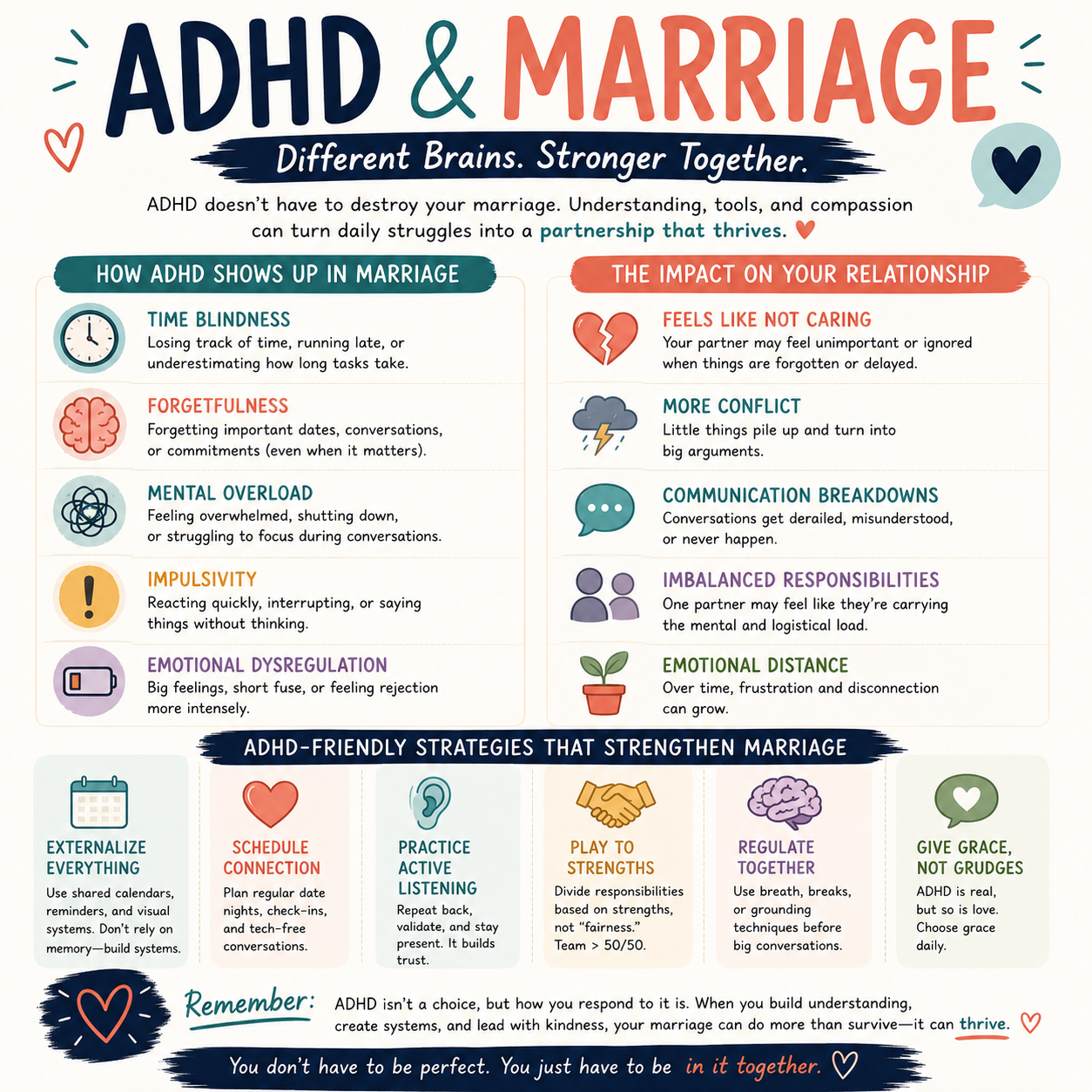
Adults with ADHD report more difficulty navigating romantic relationships and higher divorce rates than adults without it. Specifically, the inattentive presentation, not just hyperactivity, is associated with lower relationship satisfaction and less expressed affection. That matters because inattentive symptoms are often the ones a spouse experiences as personal: forgetting something that was said, missing an anniversary, seeming distracted mid-conversation. It doesn't read as neurology from the receiving end. It reads as not mattering enough to remember.
Conflict resolution patterns also differ. Research comparing couples has found that partners with ADHD, particularly combined-type presentations, show more negativity and less positivity during conflict discussions, which corresponds directly with lower relational satisfaction. This isn't a character indictment. It reflects a nervous system that reacts faster and recovers slower during emotionally charged moments, exactly the moments a marriage needs steadier footing.
A pattern clinicians who work with ADHD couples describe often is one partner (frequently, though not always, the non-ADHD spouse) gradually taking over reminders, scheduling, and follow-through, while the other feels perpetually managed rather than partnered. Neither spouse chose this. It usually develops gradually, out of necessity, and it erodes the marriage from a different angle than the original symptoms did. The spouse doing the reminding feels like a parent instead of a partner. The spouse being reminded feels like a child instead of an equal. Both resent the arrangement, even though both helped build it trying to keep things functioning.
Naming this pattern honestly, ideally with a counselor who understands ADHD specifically, tends to matter more than any single communication technique. Couples therapy that doesn't account for the neurological piece often treats recurring conflicts as a communication problem alone, when part of what's actually happening is a documented difference in attention, follow-through, and emotional recovery time.
Externalize the logistics, together, not onto one spouse. Shared calendars, written systems, and reminders that don't depend on one partner's memory reduce the number of moments that get misread as not caring.
Separate the symptom from the character judgment, out loud. "I forgot" and "I don't care" are different claims. Saying so explicitly, in the moment, prevents years of quiet resentment from accumulating around a misread signal.
Get support that understands ADHD specifically, not just generic couples counseling. The dynamics here are well-documented enough that ADHD-informed counseling exists for a reason.
Watch for the parent-child slide, and name it early. If one spouse has become the household's memory and the other has become the one being managed, that's worth addressing directly rather than letting it calcify into the relationship's default shape.
Here's what I want married couples navigating this to hear clearly: none of this excuses genuine neglect, and none of it means the non-ADHD spouse's frustration is illegitimate. Real harm happens in these marriages, and real repair takes real effort from the partner with ADHD, not just patience from the one without it.
But Scripture's picture of love in marriage was never contingent on flawless follow-through. "Love is patient and kind... it is not irritable or resentful... Love bears all things, believes all things, hopes all things, endures all things" (1 Corinthians 13:4-7, ESV). That's not a passage about tolerating dysfunction indefinitely. It's a picture of what love looks like when it's actually being asked to do something hard, which is exactly what a marriage touched by ADHD requires from both people, not just the one managing symptoms.
The ADHD spouse owes real effort: treatment, honesty, follow-through on the systems that help. The other spouse's frustration deserves to be heard, not managed away with theology. But the marriage itself was never meant to run on one partner's flawless executive function. It was meant to run on both partners extending the kind of patient, hopeful love that outlasts a bad week, a forgotten errand, or a hard season, without either one disappearing into resentment or martyrdom to make it work.
ADHD makes marriage harder in specific, documented ways: lower satisfaction tied to inattentive symptoms, rougher conflict patterns, and a real risk of sliding into a parent-child dynamic neither spouse wanted. None of that is fixed by ignoring it or by simply trying harder. It's addressed by naming the pattern honestly, getting support that understands the actual mechanism, and building a marriage on a kind of love that was always meant to bear real weight, not just coast on effortless compatibility.


.svg)
.svg)