ADHD and Dopamine: What the Research Actually Shows
A clear look at the dopamine hypothesis of ADHD, what the research supports, what it doesn't, and why brain chemistry isn't the whole story.

.svg)

"ADHD is just a dopamine deficiency" is one of the most repeated lines on the internet, and it's more oversimplified than most people realize. There's real science behind the dopamine connection to ADHD. There's also a lot of nuance that gets lost when a complicated neurochemical picture gets compressed into a single sentence for social media.
Here's what the research actually supports, and why understanding it matters for how you treat the condition, and how you talk to yourself about it.
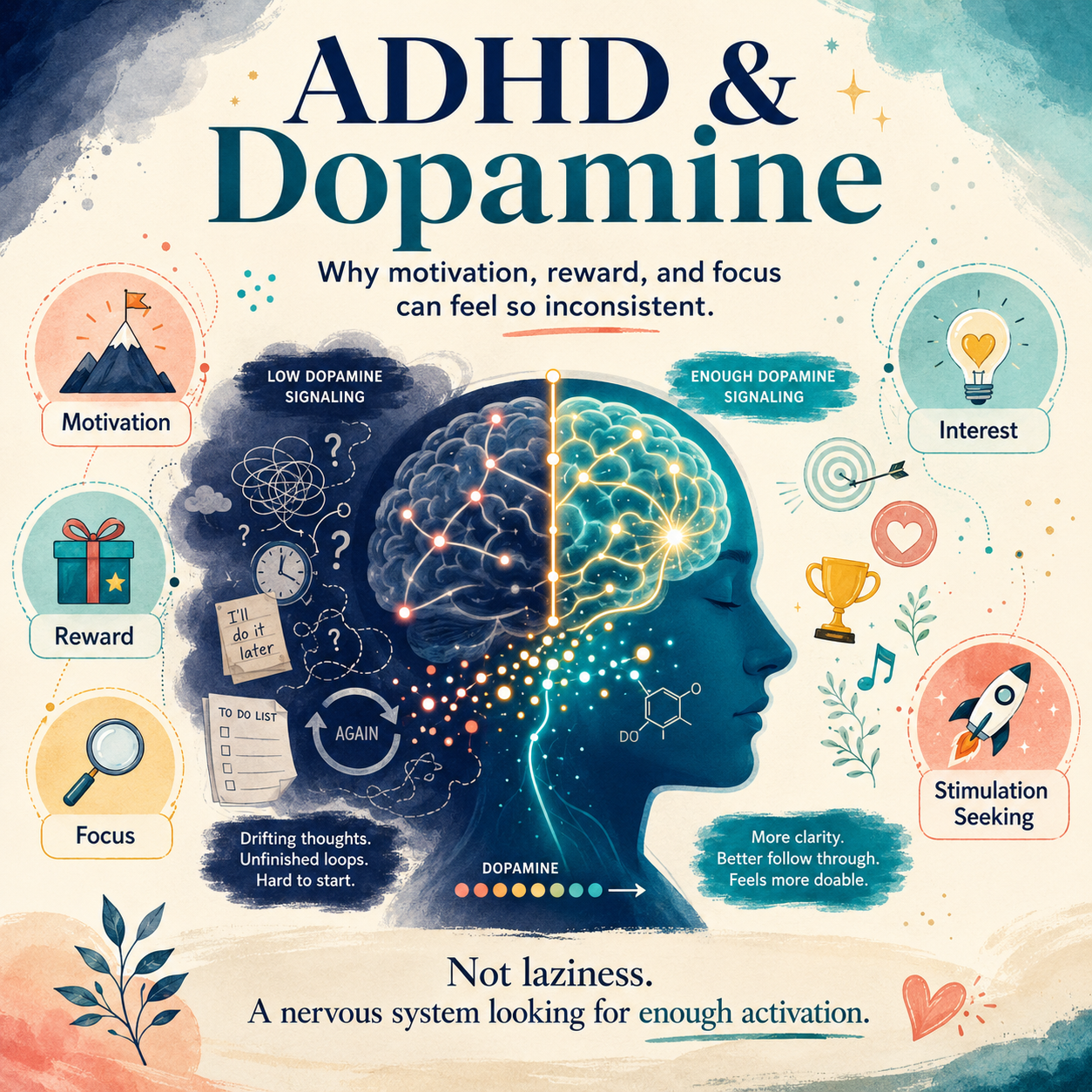
Dopamine is a neurotransmitter involved in motor control, learning, reward, and motivation. It's not simply a "pleasure chemical," despite how often it gets described that way. One of its central jobs is helping the brain decide what's worth paying attention to and acting on, based on anticipated reward.
In ADHD research, the dopamine hypothesis centers on two related ideas: reduced dopamine signaling in reward circuits, and dysregulated dopamine transmission affecting the prefrontal cortex, the region responsible for executive functions like planning, sustained attention, and impulse control. PET imaging studies, including influential work led by Dr. Nora Volkow at the National Institute on Drug Abuse, have found lower availability of dopamine receptors and transporters in the brain's reward pathway in adults with ADHD, correlated with lower measures of motivation. This is one of the more consistent findings in the field.
Genetics play a real role too. Variants in genes regulating dopamine transporters and receptors show up more frequently in people with ADHD, and heritability estimates for the condition are high, consistent with a strong biological component rather than a purely environmental one.
Here's the part that gets skipped in the oversimplified version: a comprehensive 2024 review of the dopamine hypothesis in Frontiers in Psychiatry concluded that despite decades of research, the evidence remains complex and, in places, contested. Not every study finds the same pattern. Dopamine's role likely varies across ADHD presentations, and other systems, including norepinephrine and broader networks involved in arousal and self-regulation, are clearly part of the picture too.
That matters because "ADHD is a dopamine deficiency" implies a level of settled simplicity the actual research doesn't support. ADHD is better understood as a difference in how several interacting systems regulate attention, motivation, and impulse control, with dopamine as a major, well-evidenced, but not solitary, player.
This is also why stimulant medications work the way they do. Methylphenidate and amphetamine-based medications increase dopamine availability in the synapse, primarily by blocking its reabsorption. For a brain where reward signaling is already running low, that added availability helps the executive function circuits that depend on it actually engage. It's not artificially manufacturing motivation from nothing. It's supplementing a system that's working with less than it needs.
Here's where I want to push back on two opposite errors I hear from Christians navigating ADHD.
The first error treats medication as spiritually suspect, as if adjusting brain chemistry is somehow cheating or a shortcut around the sanctification process. I reject that framing entirely. The neurochemical processes researchers are describing, dopamine, receptors, transporters, are part of an ordered creation that behaves according to real, discoverable patterns. Scripture says of Christ, "in him all things hold together" (Colossians 1:17, ESV). The consistency that lets neuroscience study dopamine pathways at all, the fact that these systems behave in predictable, researchable ways, reflects a creation held together by something more than randomness. Understanding and working within that order, including through medication, is not a workaround. It's stewardship of the way things actually are.
The second error goes the other direction: treating a dopamine explanation as the entire and final word on a person, as if once you've named the neurochemistry, you've said everything worth saying. I don't think that holds up either. A dopamine reward deficit is real and worth understanding. It is not a complete account of a person's motivation, character, or worth. Reducing a whole human being to a receptor count is its own kind of flattening, just dressed up in scientific language instead of moral language.
Both errors do the same thing from different directions: they let one part of the picture, spiritual effort or brain chemistry, stand in for the whole. The more accurate picture holds both. Real neurochemistry, worth understanding and, when appropriate, treating. A real person, not reducible to that chemistry, who is also responsible for how they respond to their circumstances over time.
Dopamine is a genuine, well-researched part of the ADHD picture, not a myth and not the whole story. The science supports real differences in reward and motivation signaling, differences medication can meaningfully help. But understanding your brain chemistry was never meant to replace understanding yourself, and it was never meant to be treated as either shameful to adjust or sufficient to explain everything. Learn the mechanism. Just don't let it become the whole verdict.


.svg)
.svg)